This column is from Trendlines, my business newsletter that covers the forces shaping the economy in Boston and beyond. If you’d like to receive it via email on Mondays and Thursdays, sign up here.
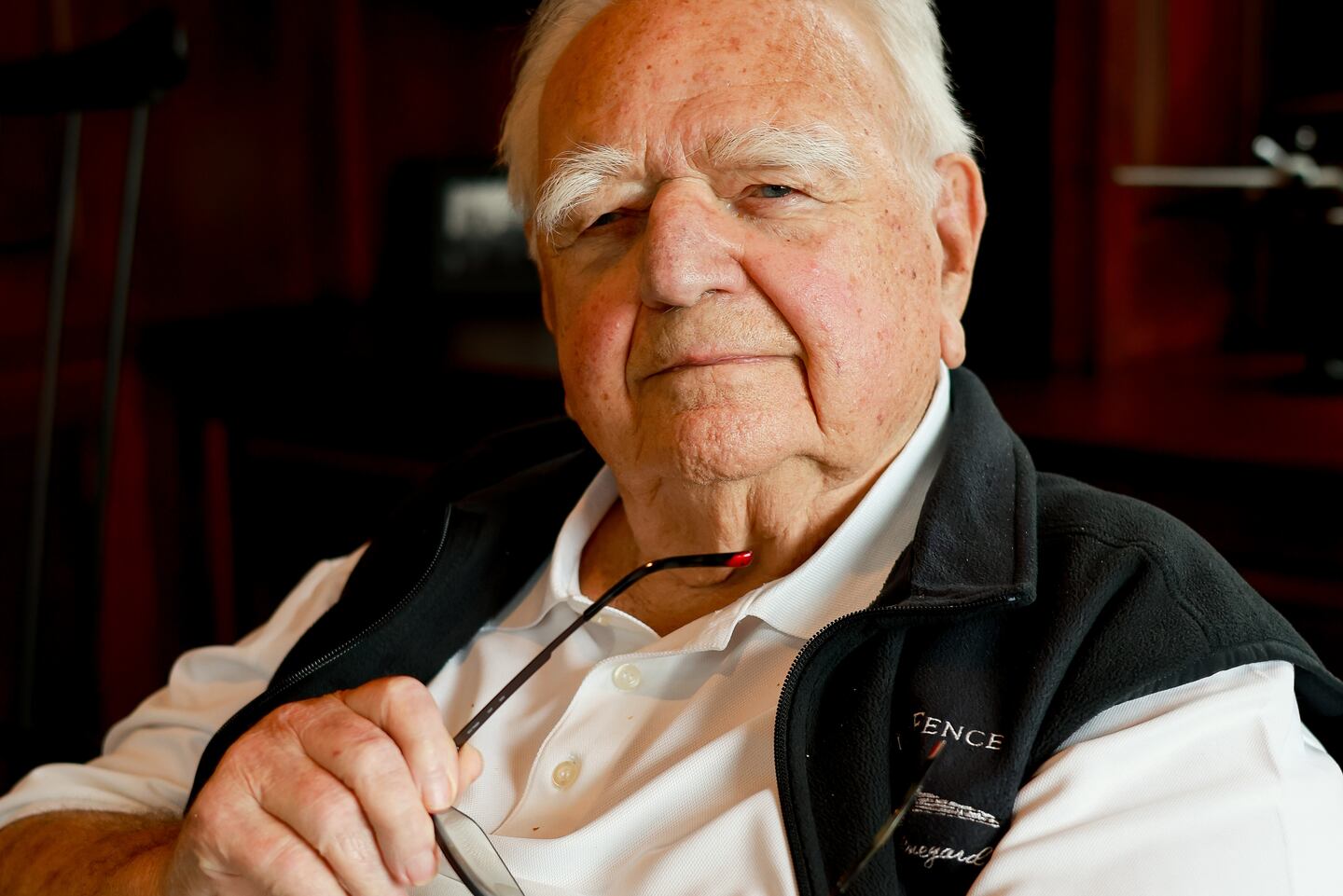
It seems Dean LeBaron was born to be a contrarian.
He grew up in Depression-era Plymouth, where, in the 1690s, his first American ancestor, a Frenchman shipwrecked in Buzzard’s Bay, became the town’s doctor. In an essay written last year in the third person, LeBaron recalled:
While Dean walked daily through Burial Hill, where the first Dr. LeBaron was buried, he knew the line from which he was sprung in this community. But rather than learning not to take chances as many did in those lean days, he leaned the opposite. His childhood motto was ‘‘by d’dleef,” loosely translated into adult lingo: “by myself,” from the age of 3 onward even to today.
LeBaron made a career out of going his own way: constructing computer-driven portfolios when Wall Street ran on gut instinct, introducing stock indexing to institutional investors before Vanguard Group’s Jack Bogle brought it to the masses, and venturing into emerging markets long before most others.
“Being contrarian tends to keep you from making mistakes while thinking about which alternatives are left over so that you can think of some ideas that really are unique, different, and right,” he said in a Harvard Business School oral history interview in 2001. “You don’t find many unique opportunities, but you may find one every five years or so, and when you do, it’s usually a big idea.”
LeBaron, who founded Boston-based Batterymarch Financial Management in 1969, grew it into one of the world’s most innovative investment firms, and sold it to Legg Mason in 1995, died July 14 at Sarasota Memorial Hospital in Sarasota, Fla. He was 92 and divided his time between Sarasota, Boston, New Hampshire, and Switzerland.
In the Harvard interview, LeBaron cited an early example of his contrarian streak: using a small plane to travel to and from the private school he was attending, which barred students from driving cars on campus.
“It’s not like I was breaking the rules. I look for ways that are acceptable, but different,” he said. (His mother insisted the story was apocryphal.)
LeBaron earned his bachelor’s degree at Harvard College in 1955 and an MBA at Harvard Business School in 1960, graduating in the top 5 percent of his class.
After working as an investment reseacher for about nine years, he decided to go out on his own when his employer rejected his idea to manage money based on ideas gleaned from academic research.
“I started Batterymarch based upon using these precepts, saying, ‘Let’s ground ourselves in solid academic research. For the price of a subscription to the Journal of Finance, we can have high-quality research about how to manage money, which nobody else is using,’” he said in the 2001 interview. “Rather than concentrating on particular companies, Batterymarch concentrated on broad market sectors.”
That approach led LeBaron to another big idea: At a time when star managers ruled the fund world, he began building passively managed portfolios designed to replicate the performance of market indexes such as the Standard & Poor’s 500. Index funds were cheaper to manage than active funds — and cheaper for clients.
“He ran some of the first institutional index funds (for AT&T, for example), four years before Jack Bogle launched the Vanguard 500,” Rob Arnott, LeBaron’s longtime friend and chair of investment firm Research Affiliates, wrote last year.
By the mid-1980s, Batterymarch’s roughly 40 employees managed assets equivalent to 2.5 percent of the entire US stock market, Arnott estimated, a share equivalent to $1.4 trillion today.
When index funds became a commodity, LeBaron looked overseas for new opportunities, investing in Brazil and other Latin American markets. The appeal: diversification, since emerging markets didn’t move in lock-step with the US, and outsize returns — sometimes 100 percent or more in a single year.
In 1989, LeBaron traveled across the Soviet Union at the government’s invitation — he carried a letter of introduction from President Mikhail Gorbachev — to develop plans to privatize the country’s defense contractors. But when the Soviet Union dissolved, the new Russian government demanded bribes for him to continue the work. LeBaron refused.
Around age 60, LeBaron decided it was time to hand over the reins of the firm. He shopped Batterymarch to buyers, striking a deal with Legg Mason, a Baltimore-based fund company.
“Batterymarch is successful and it will last for a long time,” he said in 2001. “Selling Batterymarch was the right thing to do and I’m glad I did it.”
But like so much of the fund industry, Batterymarch was eventually merged out of existence: Legg Mason combined it with QS Investors, another acquisition, in 2014, then was itself acquired in 2020 by the parent company of the Franklin Templeton Funds.
LeBaron is survived by his wife, Donna Carpenter LeBaron; his children, Stacy and Blake LeBaron; and five grandchildren.
Correction: An earlier version of this story misstated where LeBaron died.
Larry Edelman can be reached at larry.edelman@globe.com.