
For some time now, I’ve been fascinated by the case of Nicole Chuminski.
Maybe you recognize the name.
In 2010, a jury found that she’d set fire to the row house that her lover Anna Reisopoulos rented on West Sixth Street in South Boston.
Reisopoulos’s children weren’t supposed to be home that night. But firefighters found two of them — Acia Johnson, 14, and Sophia Johnson, 3 — in an upstairs closet, dead. Acia, it appeared, had been cradling her little sister against the heat and the smoke.
The region was heartbroken by the children’s deaths. But it also took a prurient interest in the stormy relationship between the girls’ mother and her female partner.
The night of the blaze, Reisopoulos had stolen a wallet at a Chuminski family wedding — causing a scene before slinking back home to South Boston.
And an irate Chuminski, police alleged, had retaliated by setting Reisopoulos’s house on fire hours later. “LOVER’S REVENGE,” blared the cover of the Boston Herald, next to Chuminski’s mug shot. “Mother’s lover arrested in fatal fire,” a Globe headline declared, a little less colorfully.

There may have been something unseemly about the media’s treatment of the women’s relationship. And something unsettling about all the time prosecutors spent on Chuminski’s sex life at trial.
But the problems with the case, I’d come to learn, ran much deeper than that.
It’s unclear if those problems will be enough to overturn Chuminski’s conviction and set her free. The New England Innocence Project, which has taken on Chuminski’s case, recently filed a motion for a new trial, but it could take months, even years, for the courts to rule.
This much, though, I can say with confidence: The fire at 154 West Sixth St. looks very different now than it did all those years ago.
This story draws on thousands of pages of transcripts, court filings, and lab reports.
The testimony
Anna Reisopoulos woke, she testified, to the sound of someone banging on her front door and screaming obscenities.
“You [expletive] [expletive],” the voice said. “Open the door!”
It was Nicole Chuminski, Anna told the jury. She was sure of it.
It had been a rough night. The couple had downed a bunch of brandy outside the wedding reception in Weymouth. They’d done plenty of drinking inside, too. And after Anna snuck off to the bathroom to do some crack, she’d made a stupid mistake: She’d stolen a wallet from one of Nicole’s relatives.
The family was livid. They’d surrounded Anna. Yelled at her. And Nicole, in tears, had told Anna she needed to leave.
“Why the [expletive] would you do that?” Nicole asked her girlfriend, outside the hall.
By one account — though Nicole denies it — she slapped Anna in the head.
Inebriated and alone, Anna wandered off into the surrounding neighborhood, hitched a ride to the T, and made her way back to South Boston.

Her kids were supposed to be staying at a family friend’s house that night. But after a trip to the playground, they’d decided to go home and watch a movie instead.
And when Anna walked through the front door, she testified, they were all asleep: Raymond Jr. in his first-floor bedroom and the girls — Raymond Jr.’s twin sister, Acia, and their little sister, Sophia — on the third floor.
Anna put on her pajamas, she said, and climbed into bed.
Later, she testified, she heard Nicole banging on the door and decided to go back to sleep rather than confront her girlfriend.
When she woke again, panic: There was “an orange ball of flame” outside her bedroom window.
“I screamed up to the third floor to Acia to get the baby and come downstairs,” she said, sobbing on the witness stand.
She dashed to Raymond’s bedroom, she said, and told her son to hustle out the back door with the family dog.
There was black smoke coming from the front of the house now.
An explosion.
Anna led Raymond out of the house, she said. Then she turned back inside. Or something like that.
“I don’t know, I’m so confused,” she said.
Somehow, she was in the backyard. And Raymond was yelling to Acia to throw the baby out the window. But she wouldn’t throw the baby.
The girls wouldn’t make it out.
“Oh, my God, my God,” Anna wailed in the courtroom. “Oh, my God. Oh, my God. Oh, my God. Oh, my God.”
The investigation
Frederick J. Hollien, a lieutenant with the Boston Fire Department, arrived on the scene in the early-morning hours of April 6, 2008.
Smoke and flames were still shooting out of the house. And firefighters were still shuffling in and out.
Hollien had fought plenty of fires in his career — some 2,000 of them. But he wouldn’t be fighting this one. For years now, he’d had a different job: fire investigator.
Once the blaze was extinguished, Hollien took charge of what’s known as the “origin and cause” phase of the investigation: walking the scene and trying to figure out where the fire started and what the cause might have been.
That morning he started, as he always did, in the areas of the house with the least damage — areas like the kitchen, where there was just a bit of blistering on the cabinets — and worked his way to the place with the most damage, the place where the fire likely started: the vestibule.
That little room was thick with char. But after examining the burn patterns closely, Hollien decided that the place of origin was the first step of a small set of stairs leading up to the interior door.
In time, he’d also land on a cause. Ruling out other possible explanations — an electrical system malfunction, say, or garbage that caught on fire — Hollien deduced that it must be arson. Someone, he would later testify at the Chuminski trial, had splashed “an ignitable liquid in that vestibule and lit the bottom step with an open flame.”
As Hollien homed in on the origin and cause of the blaze, the other phase of the investigation — the fire debris analysis — was starting to take shape.
The first step was finding anything — a piece of wood, a section of carpet, an article of clothing — that might have been doused with an accelerant. And that morning, the job fell to State Police Sergeant Stephen J. Cunningham and his accelerant-sniffing dog, a 50-pound black Labrador retriever named Yahtzee.
Handler and dog walked the property carefully. And three times, Yahtzee sat to indicate that she’d smelled something of interest: alerting to two chunks of wood on the sidewalk, believed to come from the exterior door frame of the house, and a spot inside the vestibule on a window seat.
That was not definitive proof that an accelerant was present, though. The evidence had to be sealed in metal containers and sent to the State Police crime lab for testing. Only chemists could determine whether an accelerant was really present, and if so, what kind.
The lab’s arson and explosive unit tested the debris and several articles of Chuminski’s clothing for the most commonly used accelerants: petroleum-based products like gasoline. And the results were negative.
But then Cunningham asked John Drugan, who headed the unit, to try again — testing for acetone, a flammable liquid found in nail polish remover and paint thinner.
This time, the lab came back with positive results for the two chunks of wood found on the sidewalk and for several pieces of Chuminski’s clothing.
And with that, the pillars of the prosecution were in place. There was a motive: Nicole’s anger over the stolen wallet. There was testimony placing her outside the house on the night of the fire. And with the lab results, there was physical evidence tying her to the blaze.
In February 2010, a jury found Nicole Chuminski guilty of two counts of assault and battery with a dangerous weapon and two counts of second-degree murder. The judge sentenced her to two consecutive 15-year sentences at the MCI-Framingham women’s prison, and that’s where she sits today.
All these years later, though, what once seemed like a solid case against Nicole Chuminski appears anything but.
What the jury didn’t hear
No one disputes that Nicole and Anna got into a row about the stolen wallet; the alleged motive still stands.
The other pillars of the conviction, though, are shaking.
Start with the testimony placing Nicole outside the house the night of the fire.
Chuminski’s lawyers with the New England Innocence Project have secured two affidavits that assert Anna — who testified so powerfully to the terror of the blaze — wasn’t actually home at the time of the fire.
One affidavit is from Marquita Morrissey, who grew up with Anna and was the godmother of Anna’s twins, Acia and Raymond Jr.
Morrissey, an emergency room nurse, said that she hadn’t been in contact with Anna since 2020. But they “were close friends for many years,” she said. And they “frequently spoke” about what happened the night Anna’s children died. Anna “repeatedly stated that she was not home at the time of the fire,” Morrissey said, and that her son, Raymond Jr., had to go down the street to find her and tell her about the blaze.

The second affidavit is from Mary Fox, who is serving time for second-degree murder.
She says she knew Anna in the summer of 2020. At the time, Fox was “in the throes of addiction,” she reported, and was living on the streets near the intersection of Massachusetts Avenue and Melnea Cass Boulevard.
She spent time with Anna in a park in the area, she said. And after drinking, Anna would frequently tell the story of her daughters dying in a fire in South Boston. “She would cry and was clearly emotional,” Fox said. “She would tell anyone listening in Clifford Park that she felt guilty because she had left her kids alone and was not home during the fire.” Anna never said where she was, according to Fox, “only that she had left for a short amount of time.”
There is reason to believe that Anna left the house to buy drugs.
An investigator working for Chuminski’s defense team said in an affidavit that she spoke in 2020 with a man named Royden Lungelow who claimed that Anna called him the night of the fire looking to buy drugs and that he told her to go to the public housing development to find a dealer. Lungelow has since died.
The jury never heard any of this. The affidavits were collected years after Nicole’s conviction. But there was other evidence, available at the time of the trial, that suggested Anna wasn’t home. And the jury didn’t hear any of that, either.
According to a police report filed the day of the fire, neighbors saw Anna and Raymond Jr. “running and screaming” toward the house from the direction of a nearby public housing development — an account consistent with Raymond Jr. fetching Anna after the fire started.
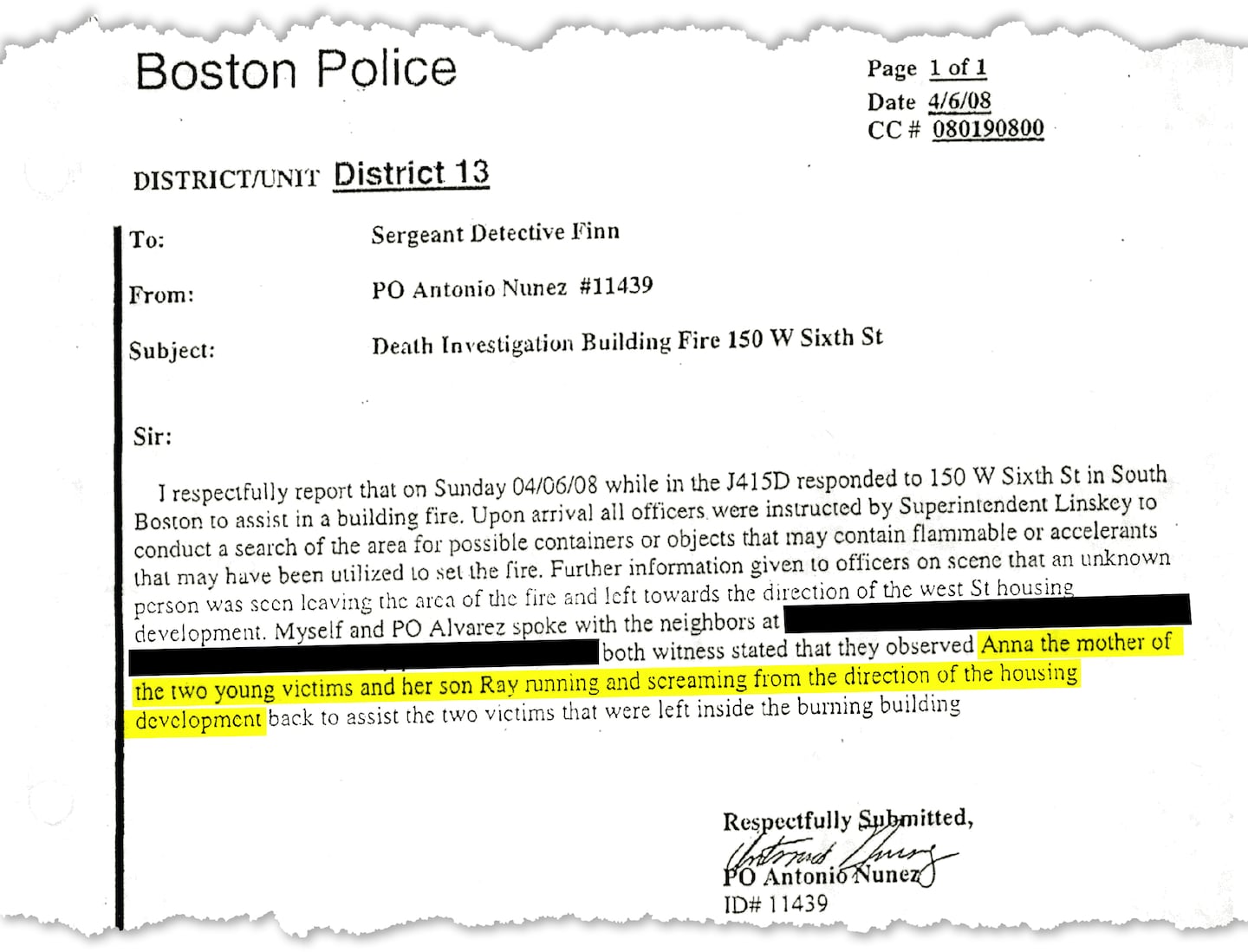
Raymond Jr., it seems, was home at the time of the fire. And at trial, he testified that he heard a woman screaming obscenities and pounding on the door earlier in the night — a woman he believed to be Nicole.
But there is reason to question Raymond’s account, too: It shifted over the course of several interviews with investigators.
If some of the most important witness testimony in the trial is in doubt, so is the science.
Start with the origin and cause investigation.
This branch of fire investigation has a long and sordid history. For years, poorly trained investigators — many of them former firefighters with little more than a high school education — traded in all sorts of folklore about the supposed telltale signs of arson, from alligator-pattern burn marks to crazed glass.
By the time of the Chuminski trial, a good deal of that junk science had been abandoned. But the field was still clinging to some dangerous mythology.
One of those myths was that the use of accelerants leads to especially intense fires. And prosecutors seemed to lean in to the notion, inducing firefighters who were on the scene — like Lieutenant William Donovan — to testify to how quickly and brightly the blaze burned.
Q: What observations did you make as you looked at the front of the house, in addition to the volume of fire?
A: The intensity, how much of the house was up in flames already. From the bottom step to the top of the door, the side windows. The fire was already licking out into the second story. The vinyl siding was already going.
Several witnesses, including Donovan, also made reference to a common maxim that fire burns up and out.
The implication was that if there was significant damage to the steps — in the lower reaches of the vestibule — the fire must have begun there and burned up, engulfing the rest of the vestibule and then the rest of the house.
Hollien, the firefighter-turned-investigator who led the origin and cause inquiry, reinforced this idea — testifying that the fire started in the “lowest area in that vestibule” and then burned up and out.
But in fact, it’s not true that fire only burns up and out. Fire burns that way at first, but once it interacts with surrounding structures, it can change direction.
And as research was just starting to show at the time of the blaze on West Sixth Street, when a fire reaches the point of “full-room involvement,” as it did in this case, it becomes much more difficult to pinpoint the origin.
Indeed, investigators often get it wrong.
As one expert put it at a symposium in 2008, the early studies showed “that far too often” in these circumstances, “investigators confused ‘lowest burn, deepest char’ type patterns as indicative of fire origin.”
There was another problem.
You’ll recall Hollien said that because he’d ruled out other causes — an electrical fire, say, or trash catching fire — he could deem the fire an arson.
Q: And after you get the area of origin, what’s your next task in your investigation?
A: My next task is to decide what ignited that fire, what was used to start that fire.
Q: Were you able to do that in this case?
A: Yes, I was.
Q: How did you do that? How did you go about doing that?
A: I go about doing that by eliminating all other causes, like accidental, garbage, space heaters, electrical, lightning. All them things I have to exclude first.
But this approach, known as “negative corpus,” was already falling out of favor at the time of the blaze. It is unscientific, after all, to back into an explanation for a fire by ruling out other possibilities rather than by finding affirmative evidence for the explanation.
And it turns out, investigators hadn’t even ruled out all the alternative explanations.
Chuminski’s lawyers at the New England Innocence Project do not dispute that the fire began somewhere in the vestibule. But as they point out in their motion for a new trial, there was electrical wiring in the ceiling of the vestibule that was never investigated — wiring that could, conceivably, have been the source of the fire.

In the lab
Fire debris analysis, unlike origin and cause, has a history of rigor.
It is legitimate science.
When labs examine a chunk of wood or piece of carpeting from a fire scene, they’re looking for the chemical signature of an accelerant like gasoline or kerosene.
But even legitimate forensic science can get distorted, as I have written elsewhere this year in Globe Opinion’s “Twisted Science” series.
And a close look reveals that it got distorted in the Chuminski case.
The state crime lab first tested the fire debris and Chuminski’s clothing for the most common accelerant in arson cases: petroleum-based products like gasoline. And the results were negative.
Case logs show Cunningham, the State Police sergeant with the accelerant-sniffing dog, then asked the lab to follow up with a second round of testing, searching for acetone this time.

The ask, itself, is worrisome.
In an impartial system of justice, a lab would be an independent actor — not one subject to the pressure of investigators eager to make a case.
And looking for acetone suggests a certain desperation: It’s not a very effective accelerant because it evaporates quickly. It’s not used in arson that frequently.
But the most unsettling part of the lab analysis was still to come.
The lab identified acetone on several articles of Nicole’s clothing and on the two chunks of wood from the exterior door frame found on the sidewalk just outside Anna’s row house. But it’s not clear that acetone found on pieces of the exterior door frame are all that relevant to a fire that started inside the vestibule.
And as Nicole’s defense team argued in the original trial, and as her New England Innocence Project lawyers point out now, acetone is ubiquitous. It’s found in clothing and shoes, in carpeting and wood products. In human sweat.
Even pyrolysis — the breakdown of materials from the heat of the fire — can produce acetone.
That’s why the gold standard for fire debris analysis, a document known as ASTM E1618, cautions that “the mere presence” of acetone isn’t grounds for a positive finding of a “foreign ignitable liquid.”
In other words, if an analyst finds a small amount of acetone, that’s not proof that someone doused a house or a car with the stuff and started a fire; the analyst could just be identifying the acetone that the manufacturer used in the flooring or carpeting.
To make a positive finding, then, an analyst must find a significant quantity of acetone.
That means running a test on a piece of fire debris or clothing and reviewing the EKG-style chart that results: Only if the acetone peak in that chart is an “order of magnitude” larger than the other peaks — that is, 10 times larger — can the analyst make a positive finding.
Look at, say, the chart for the first chunk of wood that the accelerant-sniffing dog alerted to in the Chuminski case, and you’ll see the acetone peak wasn’t remotely close to 10 times larger than the other peaks.
I spoke with Adam Hall, a forensic chemist at Boston University who served as an expert witness for the defense in the original trial. His report and testimony hit on many of the key problems with the lab’s finding.
Years later, he is still bothered by the case.
When he was on the witness stand, he said, the prosecutor “did a good job, because he was able to get me to say” that acetone was present. But the fact that it was present in insignificant quantities, he fears, may have been lost. “Either the jury didn’t understand it, or maybe there wasn’t a big enough point made about it that, you know, ‘Yes, it’s there, but what does it mean?’”
Ideally, this sort of misleading evidence would never go before a jury in the first place. The defense should have filed a pretrial motion seeking to exclude it. And because Chuminski’s original lawyers did not seek such an exclusion, they must bear some of the blame for the acetone findings going before the jury.
The lab, though, bears the ultimate responsibility for making sure the science is fairly presented.
Drugan, the lab analyst, should have noted in his report that acetone is found in a host of commercial products. He should have made it clear, too, that the presence of acetone doesn’t necessarily mean that a fire was purposely set. Indeed, the ASTM E1618 standard calls for both of these cautions.
But Drugan offered nothing of the kind in his report. Just a series of statements that the lab’s testing “identified acetone.”

Drugan acknowledged at trial that the acetone was present in “trace” quantities.
But the damage, in many ways, was already done.
Independent analysis
It’s no surprise, of course, that Chuminski’s defense would find fault with the crime lab’s findings. But I didn’t just rely on the defense experts’ analysis.
I also asked two independent chemists to look at the lab data: Eric Hazelrigg, a professor at Virginia Commonwealth University and former analyst in the State of Virginia’s forensic science laboratory, and Glen Jackson, a professor of forensic and investigative science at West Virginia University and cofounder and co-editor-in-chief of the journal Forensic Chemistry.
Jackson went so far as to review the data while “masked” — meaning he didn’t know anything about the case in advance; research shows that analysts who know something about the details of a case can produce biased analyses.
Jackson and Hazelrigg came to the same conclusion: The acetone that Drugan found on the chunks of wood and clothing appeared in insignificant quantities.
I also asked the independent analysts to review the data for two other arson cases that Drugan handled. And the review revealed problems similar to those that surfaced in the Chuminski case.
In both cases, there was data that looked on the surface as if it might reveal the presence of a “foreign ignitable liquid.” And in both cases Drugan made positive findings. But a deeper dive showed the findings were flawed.
I wrote about one of these cases — the case of Frances Choy, who was convicted of setting fire to her family home in 2003, at age 17, and killing her parents — in a recent installment of the “Twisted Science” series.
Choy was eventually exonerated.
But Robert Therrien, an architect who was convicted of setting fire to his own office in Dennis in 2001, has yet to clear his name.
And he says the conviction and the year he spent in prison afterward were devastating.
“It was a death sentence to me,” he told me, his eyes welling as we talked in his living room in Central Massachusetts a few months ago. “Everything was lost. Everything was gone. My integrity, my business, everything I achieved, my family.”
Drugan, who now runs the lab for the Boston Fire Department, declined to comment for this story.
His former employer, the state crime lab, provided a written statement, saying that while it is “unable to comment on specific cases,” it “remains committed to conducting fair and impartial evidence analysis which is presented and scrutinized in thousands of court cases each year.” The statement emphasized that the lab has “maintained national accreditation for more than two decades.” And it said the lab’s work reflects the values of “scientific excellence, objectivity, and integrity.”
The Suffolk County district attorney’s office, which prosecuted the Chuminski case, also declined to comment, citing the live proceedings over Chuminski’s motion for a new trial.
A long way to go
Nicole Chuminski has tried to make the most of her time behind bars — earning her GED, working toward a cosmetology license, training dogs to work with disabled people.
But she’s lost the prime of her life. Her hair has gone gray. Close family members have died while she’s been in prison. And she says she’s deeply anguished by the events of April 6, 2008.

“When I was first arrested in 2008, my whole world was turned upside down,” she said in a statement provided by her lawyers. “I lost everything — my girlfriend and her two kids that I loved. Everything was gone, including my freedom. I was 25 years old, and I will never get those years back. But I hope that now, with this motion, the truth will finally come out.”
I must say this, though: The case for her innocence is not clear-cut.
Even if you toss out the most problematic evidence prosecutors used against Chuminski in her 2010 trial — Anna’s testimony that she heard Nicole yelling outside the house before the fire, the deeply flawed forensic science in this case — there is still some evidence that doesn’t look great for her.
Four women Nicole encountered while she was in jail awaiting trial testified that she’d made incriminating statements.
Tammy Lewis, who was Nicole’s cellmate for a couple of months, said Nicole told her about the argument over the stolen wallet and said that later that night, “she was outside yelling and trying to get Anna to come out of the house.”
Nicole also said at one point that “the children weren’t supposed to be home,” according to Lewis.
Another of Chuminski’s fellow inmates, Angelina Dickerson, testified that Nicole told her that “she was sorry for what she did and she didn’t mean to hurt the kids.”
At trial, Chuminski’s lawyers sought to cast doubt on these accounts, emphasizing the women’s lengthy criminal records and underscoring that each of them had personal ties to Reisopoulos; Lewis and Dickerson had met Reisopoulos in jail.
In court filings, Nicole’s legal team points out that jailhouse informants often figure prominently in wrongful convictions — sometimes offering false testimony in the hope of winning lenient treatment in their own cases or other benefits. Chuminski’s lawyers are seeking documents on any such benefits the witnesses may have procured after the trial.
But there was other damaging testimony, too.
An acquaintance of Chuminski’s who saw her the night of the fire said she told him she’d thrown a beer bottle through Reisopoulos’s window, an account that seemed to match up with one theory the prosecution floated at trial: that Nicole tossed a Molotov cocktail into the house.
Here, too, Chuminski’s defense offers pushback: There was no broken glass found in the vestibule where the fire started. No wick or other remnants of a Molotov cocktail.
Still, it’s fair to say this testimony raises questions about Nicole’s innocence.
Here’s the thing, though: It would be a grave error to judge the American system of justice only by how it handles cases in which the defendant is obviously innocent or obviously guilty. Indeed, the true test of that system is the more challenging cases. The ambiguous ones.
Whatever you think happened on West Sixth Street early that morning, this should be beyond argument: Nicole Chuminski deserved a fair trial. Everyone deserves a fair trial.
And if Chuminski’s case and the others I’ve examined this year are any guide, we’re a long way from fair.
Keep your eyes on this space, though.
After one more deep dive into a pair of worrisome cases, Globe Opinion will suggest a way forward.
A way to address some of the most stubborn problems with our criminal justice system.
David Scharfenberg is the editor of Ideas. He can be reached at david.scharfenberg@globe.com. Follow him @dscharfGlobe.