
MARBLEHEAD — She knew most of his favorite songs. But that was before he started driving himself to school. He fell in love with Noah Kahan and Zach Bryan without her singing along on those morning trips.
In fact, he kept quite a bit from his mom. His accomplishments, mostly.
“I’d get messages from his friends: ‘Congratulations on Owen getting international honor society,’ or ‘Congratulations on him getting the student-athlete of the year award,’” Angela Paradise said. “He wouldn’t tell us. He was more about celebrating others.”
Long will Marblehead celebrate the life of Owen Coyne.
Coyne, one of the brightest beacons in this tight-knit coastal community, died Thursday of a brain hemorrhage. He was 17.
Since then, his family has grappled with a gutting loss and tributes have washed over the North Shore. National Grand Bank put its flag at half-staff. Dozens of meals and gifts of staggering kindness have come the family way. Before last week’s storm, someone hauled out their 24-foot Key West sport cruiser (Coyne Collection) and had it shrink-wrapped.
Hundreds of Marblehead students and families, plus athletes from Salem, Lynn, Swampscott, Danvers, and elsewhere, have been flocking to Marblehead Sport Shop to grab free T-shirts with Coyne’s football jersey number — 18 — in red and black. Store owner Jason Grazado had given away 600 of them by the close of business Saturday. He has no plans to stop making them.
“Owen meant so much to his peers and community,” Grazado said.
Coyne was captain of the Marblehead High football team, a wide receiver and safety. He was such a natural leader that when MHS teachers went on strike in 2024, Coyne was asked to help run football practices. His parents didn’t know that until a teammate mentioned it.
“He was like, ‘Oh, I actually forgot about that story,’ ” said his father, Brian, an engineer and former hockey player at Tufts, where he met Angela, now a communications professor at Stonehill. They have three younger children, Grady, 15, Landon, 12, and 8-year-old sister Ella.
Owen was a state-level track competitor in sprints and high jump — in both pursuits, top-10 in MHS history, according to coach Nolan Raimo.
“He was an unbelievable athlete, but you wanted to root for him, because he tried so hard and did everything right,” Raimo said. “He took full advantage of his gifts.”
In baseball, he used that speed in center field, and was a closer on the mound. He first dunked a basketball in eighth grade. He “created safe spaces” wherever he went, Raimo said. He was involved in Marblehead’s student-run chapter of Best Buddies.
“He was this presence of comfort and safety and courage,” said Max Kane, a classmate and close friend. “He literally had no ego. He made you want to be a better person just by being himself.”
He was close to his fellow athletes, but three of his best friends were a budding filmmaker, a photographer, and a politician.
“He liked seeing someone’s play or helping a friend shoot a movie just as much as his friends loved sitting in the stands for him on a Friday night,” Angela said, sitting next to Brian in their living room. They live in Clifton, in a home they bought as a fixer-upper when Owen was 2.
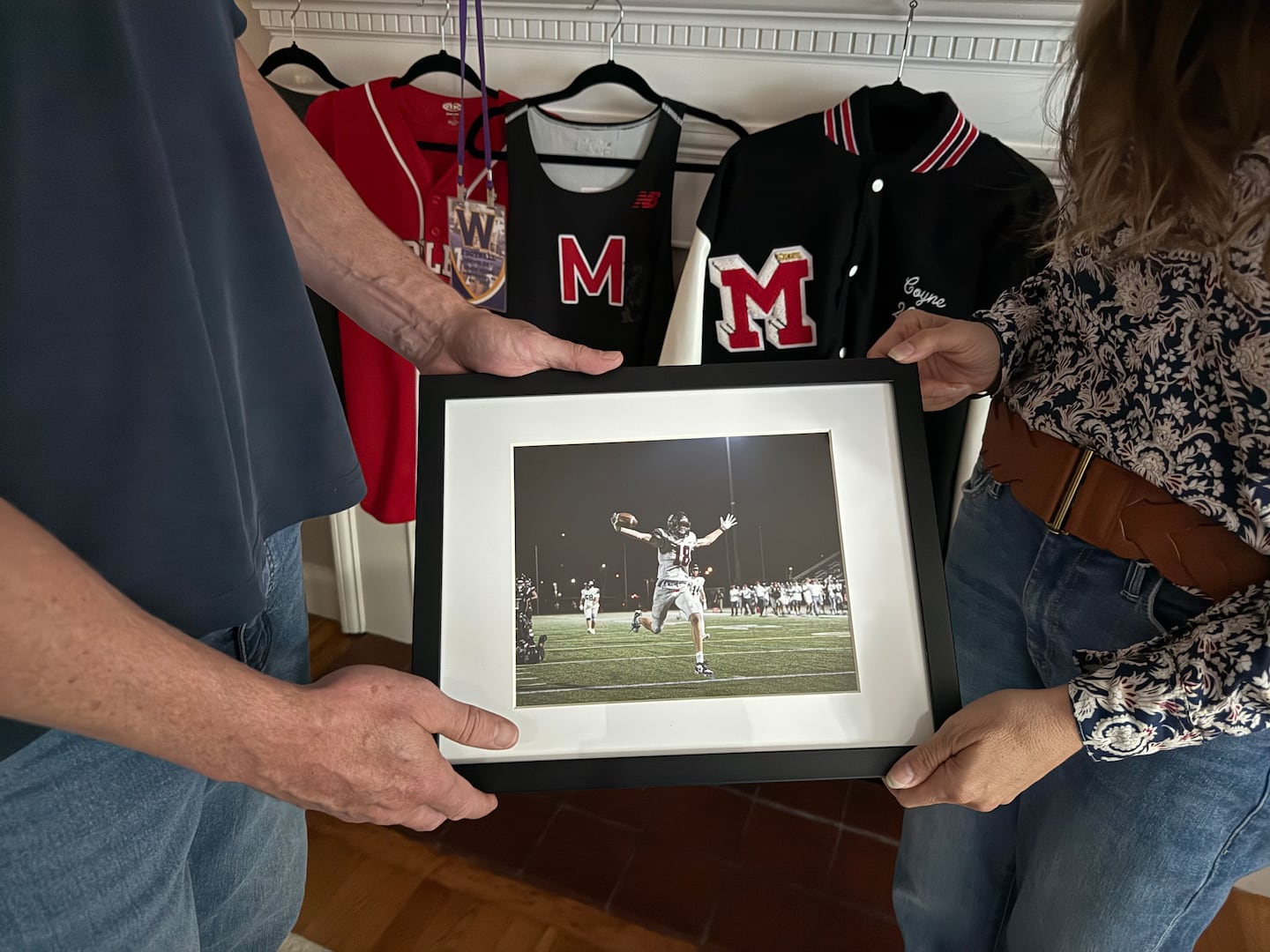
Behind them was a makeshift memorial. His letterman jacket, with a gold “CAPT.” pin. A charcoal gray Marblehead football jersey, No. 18. A red Magicians baseball button-up. A hand-drawn placard with the nickname, “OC,” the fans chanted during games. So many photos.
They held a framed action shot of Owen, holding a football, arms spread wide and feet above the turf, seemingly floating toward the end zone. It was his favorite one, though you wouldn’t have known it.
“He was a different kind of teenager,” Angela said. “One that didn’t care about clicks, didn’t care about likes, didn’t give too much thought to social media, didn’t care about posturing or posting or any of that stuff.”

Schoolwork and chores were never an issue. He preferred quality time with his pals to keg parties. He loved doing cannonballs at the pool at Corinthian Yacht Club, and even though he didn’t come from a sailing family, he became a trusted skipper. He taught sailing for the Town of Marblehead the last three summers.
Arriving for a soccer game earlier that afternoon at Marblehead High’s Piper Field, Mary Kim Koch wore a No. 18 shirt in honor of the boy who taught her how to steer a Sunfish.
“He made everyone in the class feel comfortable,” Koch said. “I was really impressed with him, as a young man being able to engage with adults in that way.”
…
Coyne’s senior year was off to a fantastic start.
While shining on the field, he was maintaining a 4.0 GPA in advanced placement and honors courses. He made his college decision: he would play football at Williams, the elite liberal arts college. He wanted to explore majors, then the world.
“He was having that first month of senior year that parents dream of for their kids,” Angela said, “athletically, academically and socially.”
On Sept. 10, he caught Marblehead’s first touchdown of the season, against Lynn English. As a safety, he recorded a slew of tackles. His parents felt it was a normal game, health-wise.
The following Friday, the 16th, Coyne awoke with a splitting headache. He had been vomiting. He texted his mom: “My head is killing me. Come here now.” At the Salem Hospital emergency room, he was examined and sent home to rest.
Two days later, he still couldn’t keep food down, and his head wasn’t any better. An MRI revealed a small bleed. He was medevacked to Massachusetts General Hospital, where doctors found an arteriovenous malformation, an abnormal tangle of blood vessels at high risk of rupture.
Initial tests were encouraging. Doctors were discussing a treatment plan that included surgery in about a month. He was stable and communicative.
His condition deteriorated over the course of a 11-night hospital stay. He slipped away.
To lift his spirits, Kane and two dozen friends brought the acoustic guitar he had been learning to play. Kane sat bedside and played the only song he knew: “Say You Won’t Let Go,” by James Arthur.
Everyone sang.
“It was the greatest honor of my life,” Kane said. “He was the best of us.”
…
Angela hopes that they’ll keep singing.
“If you see me in the supermarket, or sitting at the pool or taking a walk, I want you to come up to me and tell me a funny story about him,” she said, through tears, “so that I can continue to feel like he is still alive, just in a very different way.”
He is. When Owen got his drivers’ license last November, he signed up to be an organ donor.
Though most adults in America support organ donation, only about half are actually signed up. Teenage signup rates are surprisingly low.
When he died, his parents said, six of his organs were given to five different men between the ages of 30 and 60.
Before they are transplanted, the organs are tested.
Compared to a normal heart, doctors told his parents, Owen’s was twice as strong.

Matt Porter can be reached at matthew.porter@globe.com. Follow him on BlueSky at mattyports.bsky.social.